Showing posts with label Nevada. Show all posts

Friday, May 11, 2007

The Old Spanish Trail

The morning begins at 5:30, when I get up to drive Mom to the airport. We've been together for eleven days, through Death Valley, northern Arizona, southern Utah, and now Las Vegas. It's been a great trip. But now she has to return to Iowa, and I must return Susan & Tools' car to them in Oakland.

So now I'm headed west to the Pacific. The first part of this journey, from Las Vegas to Death Valley, will follow an old route called the Old Spanish Trail.

The trail--following ancient paths blazed by Utes, Paiutes and Mojaves--was the primary trade route across the Mojave Desert from the 1820s through the 1850s, extending about 1,200 miles from Santa Fe to Los Angeles.

The Old Spanish Trail was known as "the longest, most arduous and crookedest pack mule route in America"

Back then, trail users included traders, trappers, slavers, horse thieves, military troops and adventurers. Traders took blankets from Santa Fe to California and returned with horses bought and stolen from the west coast. Indian tribes in Utah and Nevada sold their own and other tribal members as slaves in return for European goods.

I picked up the trail heading west on Tropicana Avenue in Las Vegas. Here and there one sees a few references to this historic route.

West Tropicana Avenue in Las Vegas follows the Old Spanish Trail.


On the expanding fringe of Vegas, about 20 miles from the city

Finally, about 20 miles from the fantasy world of the Las Vegas Strip, I put the fastest-growing city in America behind me. Now I'm back in the real world...the Basin & Range, the Mojave Desert.

This was about the only car I saw as I approached the California border.


Downhill from here: Emigrant Pass, 2805 feet above sea level in Inyo County, California
N35.88422 W116.06318

The Lost Forty-Niners passed this way before becoming, well...lost in Death Valley in December 1849. Theirs in an interesting tale of impatience, greed and blunder. Click the link to find out more.

As green as it gets. Near Tecopa, California


At Tecopa I reach Hwy. 127, the north-south road where I take my leave of the Old Spanish Trail. I am about to enter Death Valley National Park, for the second time on this journey.

Next: Bad and Good Water

Wednesday, May 9, 2007

The Strip (Las Vegas: Part 2)

"Ours was the first and will doubtless be the last party of whites to visit this profitless locale." -Lieutanant Joseph Christmas Ives in 1857, on sailing up the Colorado River to a point near the present location of Las Vegas.


A remnant of the old Las Vegas Strip, before things like this muscled in...
N36.12882 W115.16735

The island of Manhattan has been transplanted here, complete with traffic.
N36.10127 W115.17355


In 1970 there were slightly more than 20,000 hotel rooms in Las Vegas. The number today is a staggering 151,000 and rising: another 11,000 are under construction, with a whopping 35,000 more on the drawing board. Vegas already has almost two times the hotel space as New York City. In fact, 15 of the world's 20 largest hotels are found in Las Vegas! The number of tourists has risen from 21 million in 1990, to 39 million in 2006. And they arrive ready to empty their pockets: tourists spent $15 billion here last year, and only 40% of that was in the casinos.

Where is some of that money spent? Let me show you...


Evidence of the secret tradeoff that allowed America to build Euro Disneyland in France


The MGM Grand is the largest hotel in the world with 5,000 rooms.
N36.10228 W115.16948

An exact reproduction of Hofbräuhaus München, with beer brewed in Munich according to the German Purity Law of 1516.
N36.10778 W115.15189


Maybe they have this on their blogs too? Lobby ceiling at the Bellagio.
N36.11307 W115.17631


Left: "The bodies of these birds are comprised of feathers and thousands of fresh Statice flowers. The legs are covered in mixed bird seed."
Right: Somebody should tell the Bellagio about this bug...even fantasy gardens require a good blast of pesticide.


"Well, Edna, that was a bit fancier than back in Des Moines."

Las Vegas Blvd., a.k.a. "The Strip" by night


Video of the hourly fountain show outside the Bellagio.
Does anyone remember we're in the Mojave Desert?

What better way to instill the love of gambling in your children than to combine it with a fairy-tale castle?
N36.09966 W115.17446

End of the day


Next: The Old Spanish Trail

Tuesday, May 8, 2007

Nothing Like It In the World (Las Vegas: Part 1)

Night panorama of the Las Vegas Strip.
Photo by Matthew Field.

Las Vegas is an urban cigarette.
Both are glamorous and seductive. One delivers nicotine, the other delivers fantasies. Imbibe and your brain chemistry becomes altered. "Enjoy me now," they seem to say. "Worry about the world another day."

Unable to resist, I succumb to the temptation to revel in the fantastic sights of the Las Vegas Strip.

The Luxor Hotel and Casino
N36.09588 W115.17339

Our reservations were at the Luxor. Never having been to Vegas before, I wanted to begin with someplace familiar, where I might recognize a thing or two. And since I had visited Luxor, Egypt several years ago, this accomodation seemed to fit the bill.

Truth be told, I wasn't really expecting them to be much alike. The Vegas version is dominated by a 30-story pyramid and a gigantic sphinx. In Egypt, those things are found, not at Luxor, but Giza, over 300 miles away. But they did have this in common: In Egypt, the tourist en route to his destination is often mobbed by many less privileged persons, who try to convince him to part with his cash. In Vegas, that function exists as well, only it has been transferred to the slot machine. Everywhere one goes, there is an opportunity to gamble on and on... I could just hear these machines calling out, "Baksheesh, baksheesh..."


Across the ocean, an older sphinx faces the Nile, the source of Egypt's wealth.
This behemoth watches McCarran International Airport, a more lucrative source of riches.


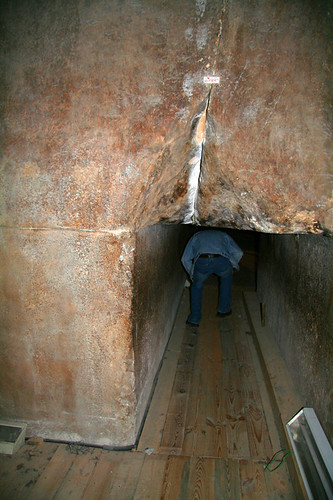
Pyramid interiors have become roomier over the centuries, and no longer smell like 4,500-year-old dirty socks. This is the largest atrium in the world.


At night, the 350-foot-high pyramid shoots forth a mega blast of light into the sky.


Next: A stroll up the Las Vegas Strip

Monday, March 26, 2007

Hoover Dam


Hoover Dam impounds the Colorado River on the Nevada-Arizona border southeast of Las Vegas. Construction was begun in 1931 and completed in 1936. Over 5,000 workers were employed during construction of the dam, which contains 3.25 million cubic yards of concrete, is 726 feet high, 660 feet thick at the base, and 1244 feet long at the crest. It was the highest dam in the world from 1935 to 1967. Hoover dam generates 4 billion KwH of electricity per year, enough for 1.3 million people.

Lake Mead was created by the Hoover Dam. Water from Lake Mead irrigates farmland in southern California and southwestern Arizona. It supplies municipal water to Las Vegas, Phoenix, and 33 communities in LA area. Lake Mead covers 247 square miles, and has 700 miles of shoreline. It is the largest man-made reservoir in the US.

While the construction of the Hoover Dam was undoubtedly an engineering feat of immense proportions, opinion is split over whether the benefits of the dam outweigh the environmental harm done.

My own opinion (it's my blog, so I guess I'm entitled) is that the benefits are more temporary in nature, while the damage is less so. Population pressures catch up again after a respite of a few decades...look at Las Vegas, which grew phenomenally in the past half-century thanks to the Hoover Dam, but is now constrained again. My thinking is largely influenced by the chapter on the Aswan High Dam in a book I read a few years ago entitled "Something New Under the Sun: an Environmental History of the Twentieth Century World" by historian J.R. McNeill.

Mom and I stopped by here after seeing Susan and Tools off at the Las Vegas airport. We are driving to Flagstaff, Arizona this evening.

Notice how low the waterline is on Lake Mead.


N36.01585 W114.73711

Ghost Town of Rhyolite, Nevada


Left: Rhyolite mercantile, Right: General store


Left: unidentified building, Right: School

Gold was discovered here in 1904, and the town had upwards of 10,000 people within three years. The Panic of 1907 is said to have crippled the town, and the mine closed in 1911. We had a nice picnic lunch next to the old train station.
N36.90083 W116.82919

Saturday, March 24, 2007

Primm, Nevada

Once I had picked up everyone at the airport, we traded in the traffic and crowds of Vegas for more crowds in literally the middle of nowhere: Primm, Utah, home of a giant casino complex, hotel, outlet mall and amusement park, all under one management. Nothing else is there, well except for a gas station.

Primm's raison d'être is explained by the fact that it lies on Exit 1 of Interstate 15, as close as one can be to California and still gamble legally. Rising like Oz from the Mojave Desert, Primm beckons to gamblers from Los Angeles who can't wait to get started, or can't bear to quit until they finally must return home.

Our reasons for staying here were twofold: 1) being Friday, hotel prices in Vegas were astronomical, and 2) we would be 38 miles closer to the places we wanted to see on Saturday.


So, we entered the smoky city/casino/hotel called Whiskey Pete's, tramped past the slot machines with our suitcases to the elevators in the back (which we shared with a somewhat drunk patron who had been ensconced here all week), and rode up to the 16th floor for a night's sleep.

Not much need for gardeners outside my hotel window.


N35.61153 W115.39249